
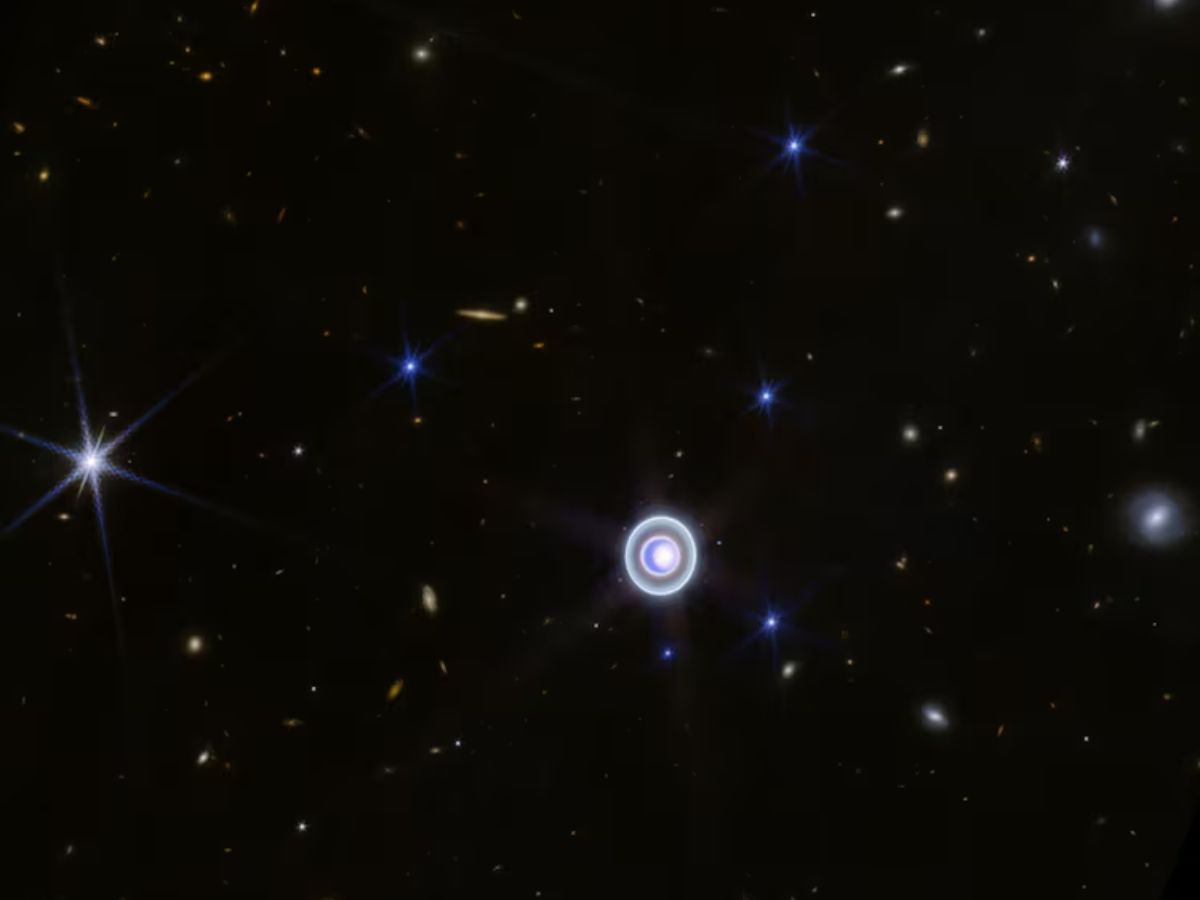

New Moon Discovered: Astronomers have spotted a tiny new moon around Uranus, thanks to the James Webb Space Telescope. This discovery reveals more about the planet’s mysterious moons, rings, and its chaotic cosmic history.
Discovery of Uranus’ New Moon S/2025 U1 by James Webb Telescope
Astronomers have identified a new moon around Uranus using the James Webb Space Telescope (JWST), dubbed S/2025 U1. The moon, which is only 6 miles (10 kilometers) in diameter, is so tiny that NASA’s Voyager 2 probe was unable to see the moon during the flyby in 1986, and other ground-based telescopes had not detected it either. Researchers at the Southwest Research Institute (SwRI) in Colorado were able to see the moon after taking 10 long exposures with the Near-Infrared Camera. With this latest discovery, Uranus has a total of 29 known moons.
Orbit, Rings, and Moons: Understanding Uranus’ Complex System
S/2025 U1 is located roughly 35,000 miles (56,000 km) from the center of Uranus, much closer than the distance from the Earth to the Moon at 238,855 miles (384,400 km). S/2025 U1 has a circular orbit near Uranus, and is presumably in its original formation in the location. The new moon exists in the very inner solar system, where there are several smaller satellites located within orbits of Uranus’ five large moons, Miranda, Ariel, Umbriel, Oberon, and Titania. Like all moons, S/2025 U1 will receive an eventual official name from the International Astronomical Union and will also be needed for the naming convention of the new moon.
Uranus has 13 faint rings surrounding it, made roughly from dark material, and also 14 inner moons that serve to stabilize the rings as they orbit the planet. The entire ring/mountain system is so chaotic and unique that it almost challenges what we might consider rings and moons.
Why the Discovery of S/2025 U1 Matters for Future Space Exploration
The finding illustrates JWST’s capabilities and that it can detect faint, small objects. Scientists think that the moon system of Uranus is more complicated than we currently think, and S/2025 U1 may be just the start of other hidden objects.
Voyager 2 is the only spacecraft we have ever had fly by Uranus back in January 1986, when there were only 5 known moons. Nearly 40 years later, we are building on the legacy of Voyager 2, and JWST continues to add to our knowledge of the outer solar system and its intriguing worlds.
Shubhi is a seasoned content writer with 6 years of experience in digital media. Specializing in news, lifestyle, health, sports, space, optical illusions, and trending topics, she crafts engaging, SEO-friendly content that informs and captivates readers. Passionate about storytelling, Shubhi blends accuracy with creativity to deliver impactful articles across diverse domains.




