
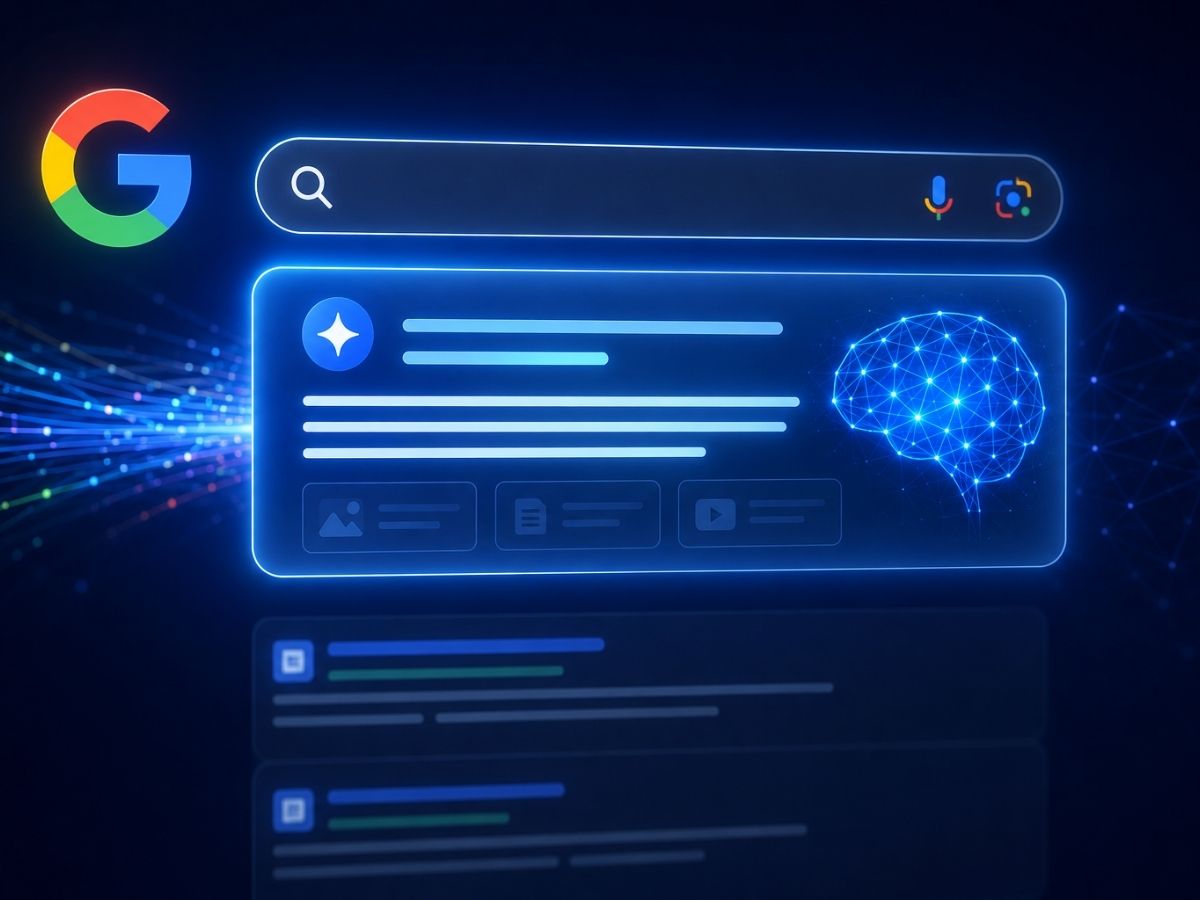
At the Google I/O conference on Tuesday, i.e. 19th May 2026 Google roll out an AI powered overhaul of search centered around a reimagined “intelligent search box” which the tech giant describes as the biggest change to this entry point of the web since the search box launched more than 25 year ago. Rather than giving a simple list of links, Google Search will drop users into AI-powered interactive experiences at times. The company is also introducing tools that can dispatch “information agents” to gather information on a user’s behalf, along with tools that allow users to build personalised mini apps tailored to their needs.
No More Blue Links
Think about how Google Search has looked for the last 25 years. You type something, you get a list of links, you click one. That was it. That is now gone. The new search box simply expands to accommodate longer, more conversational queries, rather than making you decide what type of search experience or mode you want to choose. It also has a smarter suggestion system that goes beyond basic autocomplete. You can now ask Google about things the way you would ask a person, and it will respond the same way.
This might sound like a small tweak. It is not. The entire logic of how people use the internet to find information is being rewritten here.
AI Agents That Search for You
The more interesting part is the “information agents” feature, and this one is genuinely a new territory. Starting this summer, people will be able to create, customize, and manage multiple information agents within Google Search. These agents can work in the background 24/7, track changes on the web, and alert you to new information.
Google’s Head of Search, Liz Reid, gave an example of how this works. You could send an alert to track market movements in a particular sector with very specific parameters, and the agent will map out a monitoring plan, including the tools and the data it needs to access. It will then keep track of those changes and let you know when the conditions are met and provide a synthesized update with links and information you can dive into further.
What that means in plain terms is that you will not be searching the web yourself anymore. An AI will do it for you and hand you the result.
Build Your Own Mini Apps Inside Google
There is one more feature that is easy to overlook but could be the most useful in daily life. Google will allow users to tap into its Antigravity platform to build their own customizable experiences, essentially mini apps, directly in Search using natural-language commands. For example, you could tell Google to build you a meal planning tool that checks your calendar, or a fitness tracker built around your own goals. No coding is needed. Just tell it what you want.
The new search box arrives this week; generative UI is coming this summer, and both are free. The mini-app building feature and information agents will roll out first to Google AI Pro and Ultra subscribers this summer.
What This Means for the Rest of the Web
There is one side of this story that deserves a straight answer. Publishers, news websites, blogs, and media companies have built their businesses on Google to send readers their way. These changes will likely further reduce Google referrals to publishers, which have already been suffering from declining traffic due to AI Overviews. This has already put some ad-dependent media operations out of business, and things will likely get worse.
When Google answers your question itself, you do not need to click anywhere. That is good for the user. It is a real problem for anyone whose livelihood depends on those clicks.
AI Overviews are now used by more than 2.5 billion monthly users, and Google’s conversational AI Mode tops 1 billion monthly users. Google is not experimenting with AI search anymore. It is already the product.
Syed Ziyauddin is a media and international relations enthusiast with a strong academic and professional foundation. He holds a Bachelor’s degree in Mass Media from Jamia Millia Islamia and a Master’s in International Relations (West Asia) from the same institution.
He has work with organizations like ANN Media, TV9 Bharatvarsh, NDTV and Centre for Discourse, Fusion, and Analysis (CDFA) his core interest includes Tech, Auto and global affairs.
Tweets @ZiyaIbnHameed





