
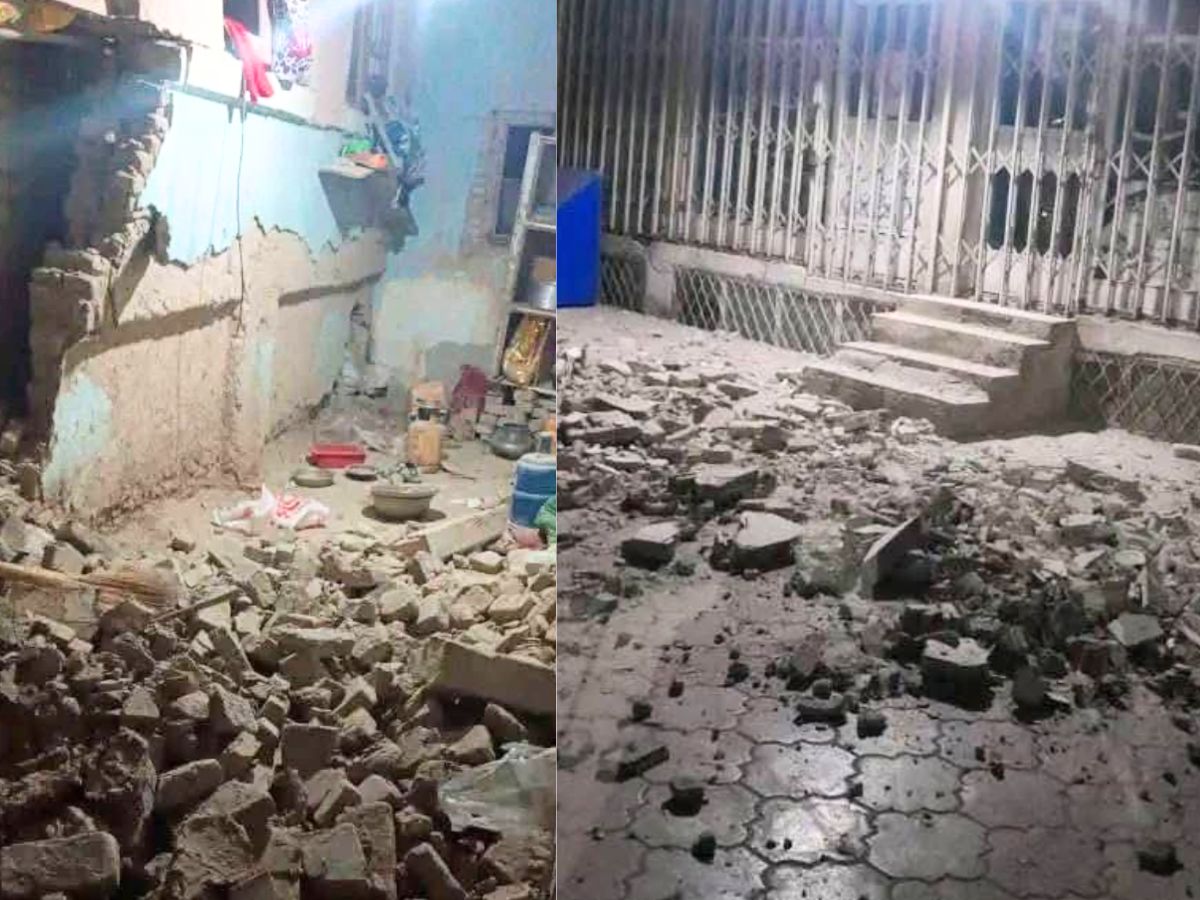

A powerful earthquake measuring 6.3 on the Richter scale struck near Mazar-e-Sharif in northern Afghanistan early Monday, leaving at least seven people dead and around 150 injured. The incident comes just months after another devastating series of quakes and aftershocks in late August that claimed more than 2,200 lives.
Why does Afghanistan experience frequent earthquakes, and can their impact be reduced?
Are Earthquakes common in Afghanistan?
Surrounded by steep, mountainous terrain and positioned at the junction of major tectonic plates, Afghanistan faces frequent seismic activity. Earthquakes are among the deadliest natural hazards in the country killing an average of 560 people annually and causing economic losses of roughly $80 million each year.
Studies indicate at least 355 earthquakes with a magnitude higher than 5.0 have hit Afghanistan since 1990.
Why is Afghanistan prone to tremors?
Afghanistan is located on the edge of the Eurasian tectonic plate, which shares a transgression zone with the Indian plate – implying the two may converge or brush past each other – and is also influenced by the Arabian plate to its south, creating one of the world’s most tectonically active regions.
The northward movement of the Indian plate and its thrust against the Eurasian plate is usually responsible for Afghanistan’s numerous quakes.
Which areas are vulnerable?
Eastern and northeastern Afghanistan, especially regions along its borders with Uzbekistan, Tajikistan, and Pakistan, are particularly prone to earthquakes.
This includes heavily populated Kabul, which has the highest average estimated damage due to earthquakes, amounting to $17 million every year, according to a study.
Earthquakes are also particularly dangerous in Afghanistan’s mountains where they can trigger landslides, exacerbating loss of life and property.
Which were Afghanistan’s worst earthquakes?
Afghanistan has recorded around 100 “damaging” earthquakes since 1900.
Among the worst in recent years was a magnitude 6 quake in 2022 that killed 1,000 people. Multiple quakes in one month in 2023 together killed 1,000 people and destroyed entire villages.
One of Afghanistan’s largest earthquakes, with a magnitude of 7.5, struck in 2015, killing 399 people in Afghanistan, Pakistan and India.
Some of the greatest devastation was seen in 1998 as two earthquakes shook Afghanistan within three months – the first killing 2,300 people and the second 4,700.
How can Afghanistan build resilience?
Studies recommend new structures be built in an earthquake-resistant way and existing buildings be retrofitted to reduce chances of collapse.
Better monitoring and early warning systems must also be created for more timely alerts, while fault lines should be mapped using geospatial and remote sensing technologies to enable relocation of people in vulnerable areas, they suggest.
(With Reuters Inputs)
Sofia Babu Chacko is a journalist with over five years of experience reporting on Indian politics, crime, human rights, gender issues, and stories about marginalized communities. She believes journalism plays a crucial role in amplifying unheard voices and bringing attention to issues that truly matter. Sofia has contributed articles to The New Indian Express, Youth Ki Awaaz, and Maktoob Media. She is also a recipient of the 2025 Laadli Media Awards for gender sensitivity. Beyond the newsroom, she is a music enthusiast who enjoys singing. Connect with Sofia on X: https://x.com/SBCism




