
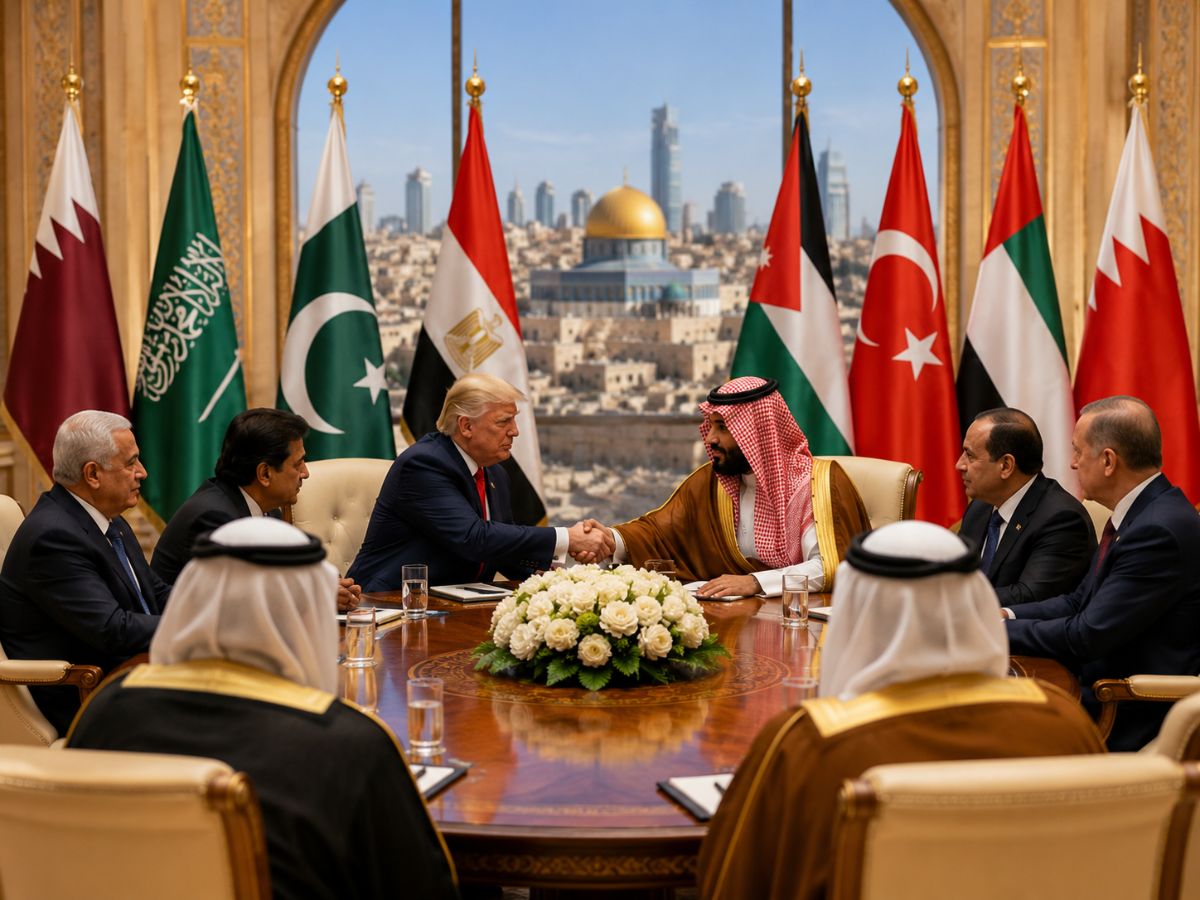
US President Donald Trump on Monday pushed for a major expansion of the Abraham Accords as part of the ongoing negotiations with Iran, urging several Muslim-majority countries including Qatar, Saudi Arabia, Pakistan, Egypt, Jordan and Turkey to normalize relations with Israel. Trump said these countries could join what he called an “unparalleled World Coalition” if Iran signs a final agreement with the United States to end the ongoing regional conflict. The development has once again brought global attention to the Abraham Accords, the diplomatic framework first introduced during Trump’s first term in office to reshape ties between Israel and Arab nations.
How Trump linked the Abraham Accords to the ongoing Iran peace negotiations
In a post on Truth Social, Trump said he had spoken with leaders of Qatar, Saudi Arabia, Pakistan, Egypt, Jordan, Turkey, the United Arab Emirates and Bahrain regarding the future of the Abraham Accords and broader peace efforts in West Asia.
“I am mandatorily requesting that all Countries immediately sign the Abraham Accords, and that, if Iran signs its Agreement with me, as President of the United States of America, it would be an Honor to have them also be part of this unparalleled World Coalition,” Trump wrote.
He added that the United States had done extensive work “to try and pull this very complex puzzle together.” Trump also said the ongoing talks with Iran were “proceeding nicely,” although he did not suggest that a final agreement was close.
What exactly are the Abraham Accords and why were they created?
The Abraham Accords are a set of diplomatic agreements brokered by the United States in 2020 during Trump’s first presidency. The agreements aimed to normalize relations between Israel and several Arab nations that had historically refused formal ties with the country.
Under the Abraham Accords, the United Arab Emirates and Bahrain became the first Arab countries in nearly 25 years to officially recognize Israel. Morocco and Sudan later joined the framework as well.
The agreements were viewed as a major geopolitical shift because many Arab nations had previously linked recognition of Israel to the creation of an independent Palestinian state. The Abraham Accords changed that approach by focusing more on regional cooperation, trade, security and economic partnerships.
Why Trump wants more Muslim-majority countries to join now
Trump now appears to be using the Abraham Accords as part of a wider strategy tied to the Iran negotiations and efforts to stabilize the Gulf region. According to his statement, bringing more Muslim-majority nations into the framework could help strengthen regional cooperation and isolate conflict.
Trump also suggested that Iran itself could eventually become part of the Abraham Accords if a peace agreement is finalized. He said countries he contacted would be “honored” to have Iran included once the war ends.
However, not every country appears ready to move ahead immediately. Trump admitted that “one or two” countries may have reasons not to join, though he insisted most were “ready, willing, and able” to support the initiative.
Why Saudi Arabia remains one of the biggest missing pieces
While the Abraham Accords expanded rapidly during Trump’s first term, Saudi Arabia still remains outside the agreement despite repeated diplomatic efforts by Washington.
Trump had earlier expressed confidence that Saudi Arabia would eventually join after a Gaza ceasefire last year. However, Riyadh has shown little interest so far.
Meanwhile, Egypt and Jordan already have official diplomatic relations with Israel, though they are not part of the Abraham Accords framework signed in 2020.
(via agency inputs)
Khalid Qasid is a media enthusiast with a strong interest in documentary filmmaking. He holds a Master’s degree in Convergent Journalism from AJK MCRC. He has also written extensively on esports at Sportsdunia. Currently, he covers world and general news at NewsX Digital.





