
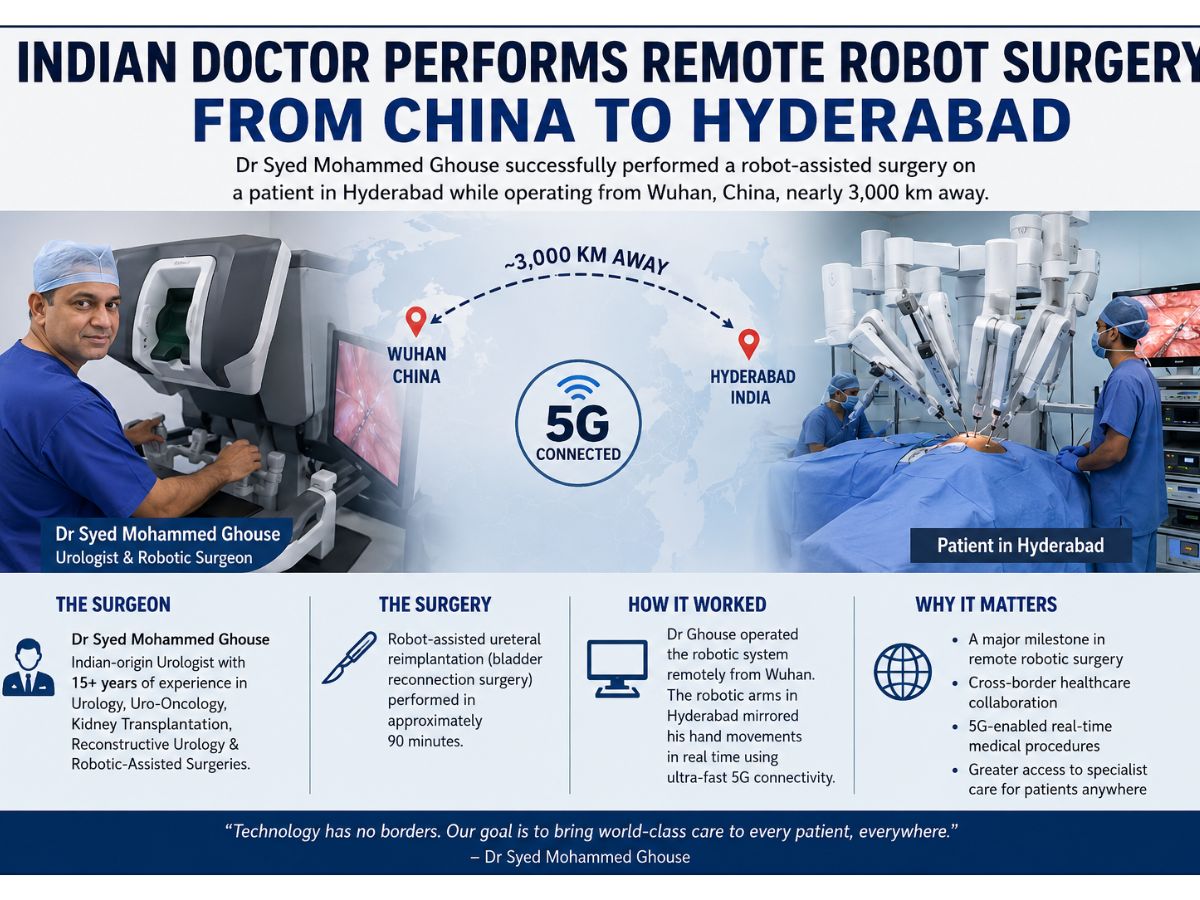
In this remarkable medical breakthrough, Indian urologist Dr Syed Mohammed Ghouse managed to carry out a robot-assisted surgery on a patient in Hyderabad, while in the middle of operating from Wuhan, all that time nearly 3,000 kilometres away, somehow. The whole thing is now being praised as a huge milestone for telemedicine, robotic surgery and cross-border health care collaboration.
Who is Dr Syed Mohammed Ghouse?
Dr Syed Mohammed Ghouse is an Indian-origin urologist and robotic surgeon, too, with over 15 years of experience in urology, uro-oncology, kidney transplantation, reconstructive urology, and robotic-assisted surgeries. People usually recognise him for doing minimally invasive procedures, plus the more advanced robotic methods, that kind of work.
Recently, Dr Ghouse was working at Tongji Hospital, which is one of China’s leading medical institutions, and there he carried out that groundbreaking remote operation.
What Surgery Did He Perform?
Dr Ghouse apparently did it remotely, kinda not too straightforward, in the way people usually describe it. He performed a robot-assisted ureteral reimplantation, sort of a bladder reconnection, on a patient in Hyderabad. The entire episode was pretty complex, because the ureter needed to be brought back to the bladder using a robotic setup, and it was wrapped up in around 90 minutes, or so.
-
Advanced robotic surgical technology developed in China
-
High-definition 3D imaging systems
-
Ultra-fast 5G connectivity for real-time control
-
Coordinated medical teams in both Wuhan and Hyderabad
How Was the Remote Surgery Conducted?
Before the operation, doctors in China and India kinda jointly reviewed the patient’s medical records, and they made a pretty detailed surgical plan as well. While Dr Ghouse controlled the robotic system remotely from Wuhan, a local medical team in Hyderabad took care of patient preparation, anaesthesia, and the operating room support, sort of all the while.
The successful surgery showed, in practice, how modern telecommunications plus robotic technologies can let specialists do the work on patients across international borders without having to be physically present.
Why Is This Surgery Significant?
-
Remote robotic surgery
-
Cross-border healthcare delivery
-
5G-enabled medical procedures
-
Access to specialist treatment in distant locations
A New Era for Global Healthcare
The successful Wuhan to Hyderabad robotic surgery kind of shows the growing potential of telesurgery, and you can see it more and more. As communication networks get faster, and robotic systems get even more sophisticated, then similar procedures might become much commoner over time. That could allow expert surgeons to treat patients from anywhere across the world, without the usual travel hassle, I mean.
Saniya Siddique is a skilled Content Writer with a background in Journalism. Specializes in creating engaging, accurate, and audience-focused content, with expertise in news writing, digital media, and writing trendy articles on buzz and entertainment.





