
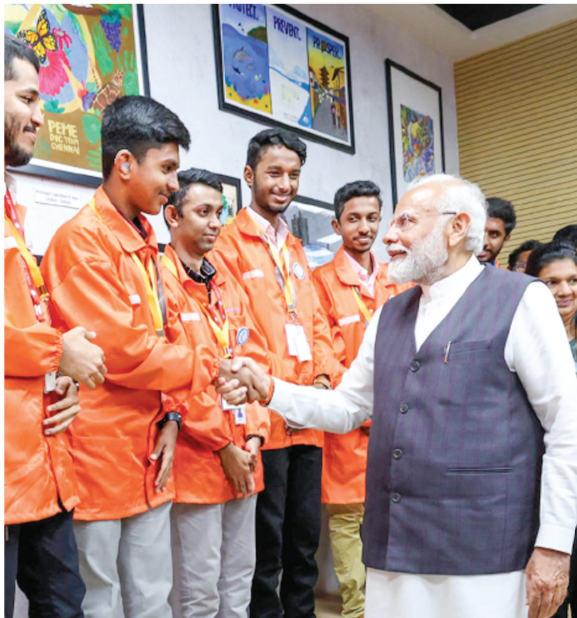

Prime Minister Narendra Modi has often said that India’s true strength lies in its “two limitless powers – democracy and demography.” With the world’s largest young population, India today stands at a pivotal moment in history. How the country educates, skills, and empowers its youth will determine the trajectory of its growth.
Over the past eleven years, the Modi government has sought to transform India’s youth – the Amrit-Peedhi – into catalysts of innovation, enterprise, and national pride. Through reforms such as the National Education Policy (NEP) 2020, massive skill development programmes, youth employment initiatives, entrepreneurship promotion, defence reforms, and sports development schemes, India is scripting a new story for its younger generation.
National Education Policy 2020: A Paradigm Shift
One of the most ambitious reforms in India’s education sector came with the launch of the National Education Policy (NEP) 2020. Introduced after more than three decades, NEP aims to overhaul India’s outdated educational framework, making it learner-centric, flexible, and rooted in Indian ethos while aligned to global standards.
The policy envisions a 5+3+3+4 structure of schooling, universalising early childhood care and education, and emphasising critical thinking over rote learning. It also lays strong focus on vocational training, coding, digital literacy, and multidisciplinary higher education.
In the last 11 years, India has witnessed the opening of 7 new IITs, 8 new IIMs, and the tripling of AIIMS across the country. Over 2,045 medical colleges, including Allopathy, Dental, and AYUSH institutions, have been added, alongside 490 new universities and 14,500 schools upgraded under PM SHRI Yojana.
These investments have broadened access, created opportunities for millions, and strengthened India’s march towards becoming a global knowledge superpower.
Skilling for Employment: Kaushal Vikas Yojana
Education alone is not enough without employability. Recognising this, the government launched the Pradhan Mantri Kaushal Vikas Yojana (PMKVY) to skill India’s youth in modern and market-driven trades.
Since its inception, 1.6 crore youngsters have been trained under PMKVY. The programme focuses on skilling, upskilling, and reskilling, aligning training with industry demand. New qualification packs in capital goods, welding technologies, and digital trades have expanded the scope of training.
These initiatives have not only boosted employment prospects but also addressed India’s long-standing skill gap, preparing its workforce for the demands of Industry 4.0.
Employment Opportunities: Rozgar Mela
To directly address job creation, the Modi government launched the Rozgar Mela, a recruitment drive to provide 10 lakh jobs in the Central government. In addition, robust economic growth and policy reforms have generated lakhs of jobs annually.
Between 2017 and 2025, 8.59 crore new EPFO accounts were added, each representing a formal job. Even during the pandemic years, over 1.09 crore new accounts were created in 2021-22, showing resilience in India’s labour market.
Exports reaching a record USD 824.9 billion in 2024-25 further demonstrate how employment is being generated through manufacturing and services expansion.
Entrepreneurship and Innovation: Startup India
India’s youth are no longer content with being job seekers. They are increasingly becoming job creators, thanks to a favourable ecosystem shaped by the Startup India mission launched in 2016.
In just over a decade, India has emerged as the third largest startup ecosystem in the world. More than 1.6 lakh startups are officially recognised, creating over 17.6 lakh jobs. Many of these startups are based in Tier-2 and Tier-3 cities, signalling a democratisation of entrepreneurship.
The government has supported this ecosystem with tax benefits, funding support, compliance simplification, and initiatives like the Atal Innovation Mission. Between 2017 and 2024 alone, recognised tech startups created 4.8 lakh direct jobs, while countless others contributed indirectly to India’s growth story. PM Modi often highlights that risk-taking is no longer frowned upon. The mindset has shifted—India now celebrates its entrepreneurs as “nation builders.”
Defence Reforms: Agnipath Yojana
In 2022, the government introduced the Agnipath scheme, a transformative recruitment model for the Armed Forces. Under this, young men and women between 17.5 and 21 years are recruited as Agniveers for a four-year tenure.
The scheme provides them with rigorous training, discipline, and exposure to cutting-edge defence technologies. After completion, Agniveers can pursue careers in various fields with priority in state police, CAPFs, and corporate sectors. Agnipath is not just a manpower reform; it is a cultural shift in the Armed Forces. It injects “Josh” and “Jazba” into India’s defence while instilling in young people qualities of patriotism, resilience, and responsibility.
Sports Achievements: From Khelo India to Global Podiums
Sports, once considered a distraction, have now been placed at the heart of India’s youth development strategy. The Modi government launched the Khelo India programme to promote grassroots participation and build a sporting culture.
Over 1,048 Khelo India centres have been established, nurturing talent at the district level. The Target Olympic Podium Scheme (TOPS) has given direct financial and technical support to athletes, leading to India’s best-ever performances at the Tokyo Olympics (2021) and Paris Paralympics (2024).
India secured 61 medals across the two editions, a record haul that reflects long-term planning and government commitment. Programmes like the Fit India Movement have simultaneously promoted health and wellness across society, linking sports to holistic development.
Youth as Drivers of India’s Amrit Kaal
The empowerment of the Amrit-Peedhi is central to India’s vision for Viksit Bharat 2047. By investing in education, skills, jobs, entrepreneurship, defence service, and sports, the Modi government has laid a robust foundation for India’s youth to thrive.
The transformation is visible:
-
NEP 2020 is redefining classrooms and higher education.
-
PMKVY is bridging the skill gap for new-age industries.
-
Rozgar Mela and economic reforms are opening up formal employment avenues.
-
Startup India is making risk-takers into wealth creators.
-
Agnipath is forging a tech-savvy, disciplined generation of patriots.
-
Sports schemes are nurturing champions who bring glory to India.
As India steps into its centenary of independence in 2047, the Amrit-Peedhi will hold the reins of the nation’s destiny. The past eleven years have been a period of preparation—building institutions, creating opportunities, and shifting mindsets.
With education reforms, employment drives, entrepreneurial support, military reforms, and sporting excellence, India is not merely preparing its youth for jobs—it is preparing them for leadership in every field.
Prime Minister Modi’s vision of “India First” resonates deeply with this generational transformation. In nurturing the aspirations of the youth, India is not only securing its present but also shaping a future where the world sees it as a true knowledge superpower, an innovation hub, and a sporting nation.
The Amrit-Peedhi is not just the promise of tomorrow—it is the powerhouse of today.
Manisha Chauhan is a passionate journalist with 3 years of experience in the media industry, covering everything from trending entertainment buzz and celebrity spotlights to thought-provoking book reviews and practical health tips. Known for blending fresh perspectives with reader-friendly writing, she creates content that informs, entertains, and inspires. When she’s not chasing the next viral story, you’ll find her diving into a good book or exploring new wellness trends.




