

India’s infrastructure story under Prime Minister Narendra Modi has transformed from decades of delays to a new era of speed, scale, and world-class delivery.
Breaking the Cycle of Delays For decades, India’s infra- structure projects were marred by delays, cost overruns, and bureaucratic hurdles. This changed un- der Modi’s leadership. The government introduced the PRAGATI (Pro-Active Governance and Timely Implementation) platform, enabling the Prime Minister to personally monitor prog- ress and ensure accountability. As a result, long-stalled projects were revived, and newly announced ones were completed on time. This shift from delays to de- livery has redefined India’s infrastructure ecosystem, instilling confidence among investors, developers, and citizens alike.
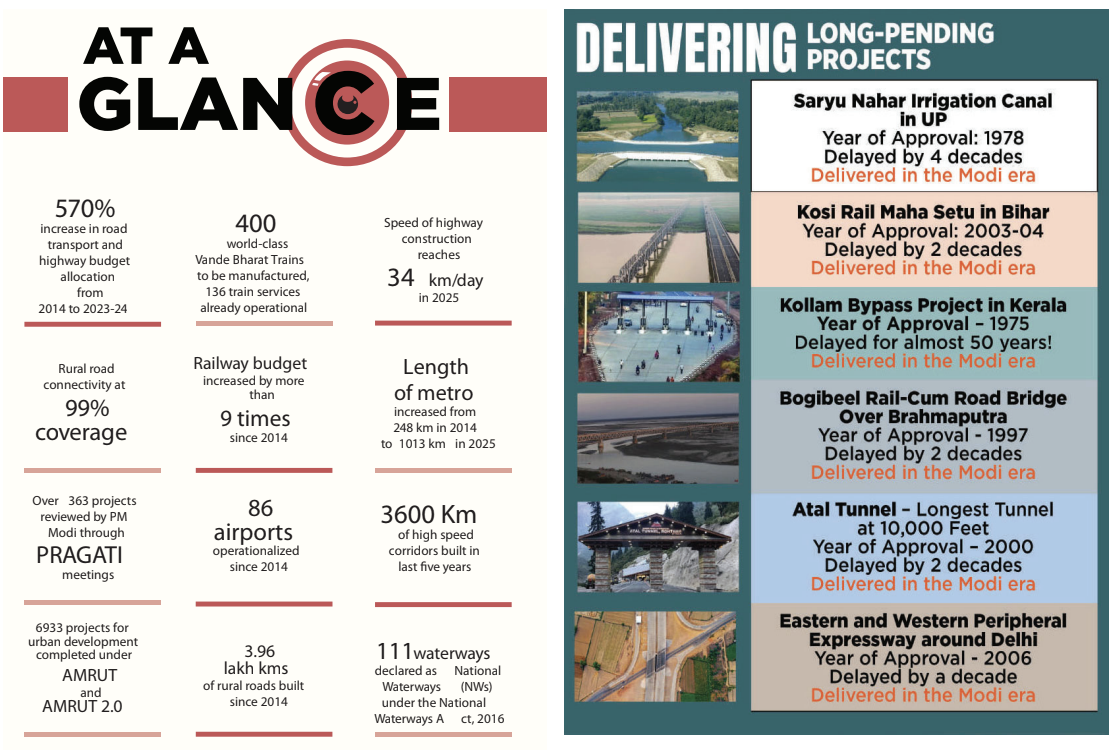
Roads and Highways: Driving Connectivity One of the standout achieve- ments has been in road and highway construction. The daily highway construction average has consistently stayed above pre-2014 lev- els, reaching a record of 34 kilometres per day in 2025. Investments in expressways and corridors have enhanced logistics efficiency and dras- tically cut travel time. The Delhi–Vadodara ex- pressway, where a 2.5 km four-lane concrete pavement was built in just 24 hours, and the Solapur–Bijapur NH-52 section, where 26 km of road was laid in just 21 hours, are shining exam- ples of India’s capacity to deliver at world standards. Budget allocations for road transport and highways have surged by 570% since 2014, showing the government’s unrelenting focus on this sector.
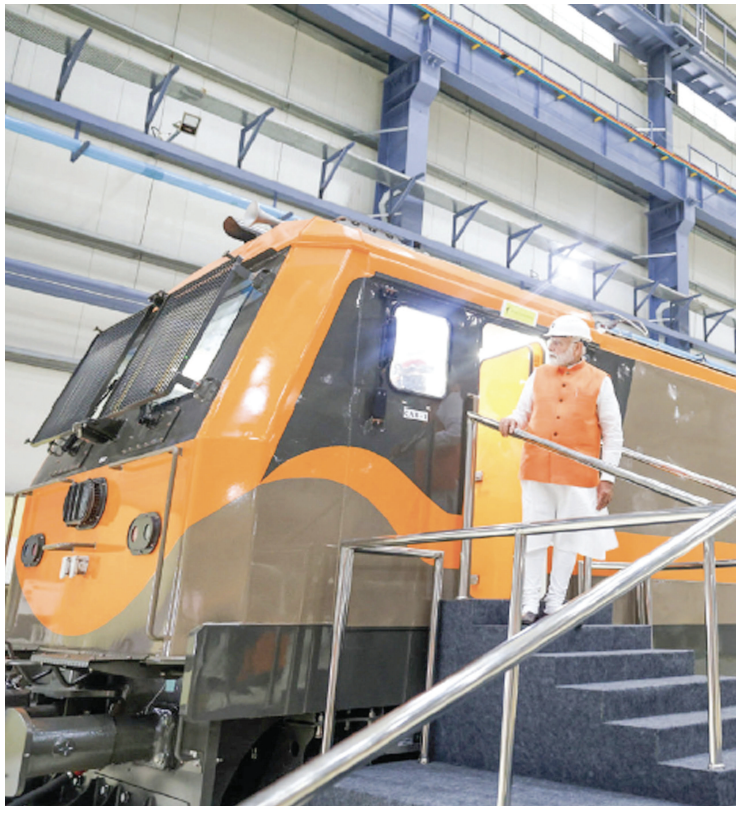
Railways:Modernisation at Speed Indian Railways has under- gone the most significant transformation in decades. Line doubling, electrifica- tion, and capacity expan- sion have been aggressively pursued. The Vande Bharat semi high-speed trains, en- tirely indigenously designed and manufactured, symbol- ise the success of “Make in India.” By 2025, 136 Vande Bharat services were operational, with plans for 400 more trains in the coming years. The Amrit Bharat Station Scheme is modernising sta- tions nationwide, with 103 redeveloped railway sta- tions inaugurated recently. Ambitious projects like the Chenab Bridge, the world’s highest railway bridge, and the Atal Tunnel, the lon- gest highway tunnel above 10,000 feet, highlight en- gineering excellence and resilience.
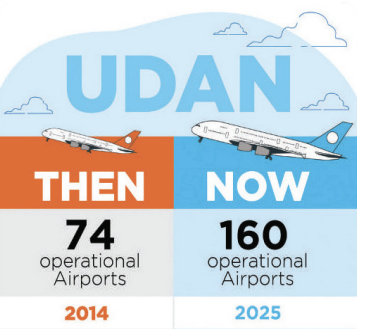
Aviation: Taking Air Travel to the Masses Air connectivity has expand- ed dramatically. Since 2014, 86 new airports have been built and operationalised, with the UDAN scheme connecting 88 underserved/ unserved destinations in- cluding airports, heliports, and water aerodromes. What was once considered a luxury for the elite has now become accessible for the common citizen, thanks to affordable regional flights. Recent landmarks like the New Pamban Bridge inaugu- rated in 2025, and projects such as the Navi Mumbai Atal Setu, have strengthened inter-city and regional con- nectivity while easing traffic congestion.
Metro and Urban Transit: Expanding Urban Horizons Metro rail, once confined to a handful of cities, has now expanded to 23 cities across India, with the operational metro network length in- creasing from 248 km in 2014 to over 1,000 km in 2025. This has transformed urban commuting, reduced reliance on private vehicles, cut emissions, and improved quality of life for millions. Alongside, projects under AMRUT and AMRUT 2.0 have completed 6,933 ur- ban development projects, ensuring smarter cities and sustainable growth.
Maritime and Waterways: Strengthening Trade Links India has embraced its maritime potential, de- claring 111 waterways as National Waterways un- der the 2016 Act, thereby boosting inland water transport. Large-scale projects such as the up- coming Vadhavan Port, set to become India’s largest container port, reflect the country’s intent to integrate seamlessly into global trade systems and reduce logistics costs.
PM Gati Shakti: A Holistic Approach At the heart of this trans- formation lies the PM Gati Shakti National Master Plan (NMP)—a revolution- ary initiative for integrated infrastructure planning. Bringing together 44 min- istries and all states/UTs on a single digital portal, it enables real-time tracking, inter-departmental coor- dination, and efficient use of resources. The plan en- visions Rs 100 lakh crore worth of infrastructure in- vestment, focusing on mul- timodal connectivity to en- sure the smooth movement of people and goods. By institutionalising planning and removing silos, Gati Shakti promises cost savings, faster execu- tion, and reduced disrup- tions, setting a new benchmark in governance.
Logistics and National Prosperity The National Logistics Policy complements Gati Shakti by targeting a re- duction in logistics costs, which have long been a bottleneck in India’s com- petitiveness. Improved multimodal linkages will not only enhance domes- tic trade efficiency but also make Indian exports more competitive globally. This will directly benefit start- ups, businesses, and farm- ers, creating a ripple effect across the economy.
Engineering Feats and National Pride India’s infrastructure jour- ney under PM Modi has also delivered projects of immense symbolic and practical significance:
• Statue of Unity: The tall- est statue in the world, now a global tourism landmark.
• Sudarshan Setu: In- dia’s longest cable-stayed bridge, connecting Okha main land with beyt Dwarka.
• Atal Setu, Navi Mumbai: Built at a cost of Rs 17,840 crore, easing urban mobility.
• World-class express- ways and tunnels in geo- logically challenging ter- rains, showcasing India’s engineering prowess. These projects reflect not just physical development but also the confidence of a nation moving rapidly to- wards modernisation.
Rural Connectivity: Reaching the Last Mile Infrastructure growth has not been confined to urban areas. Rural India, too, has been transformed. Since 2014, 3.96 lakh km of rural roads have been built, achieving 99% rural road connectivity. This has brought markets, health- care, and education within easier reach for millions of villagers, dramatically im- proving rural livelihoods and reducing regional disparities.
Employment and Economic Multiplier Effect Infrastructure creation is also one of the largest gen- erators of employment. From construction labour to advanced engineer- ing, millions of jobs have been created directly and indirectly. The multiplier effect of infrastructure spending is evident in ris- ing incomes, improved lo- gistics for businesses, and increased foreign invest- ments in India’s growth story.
A Vision for Amrit Kaal As India moves into Amrit Kaal, the vision is clear: world-class infrastructure will be the bedrock of a developed India. Projects worth trillions of rupees in roads, rail, aviation, and urban infrastructure will ensure last mile connectivity, spur job cre- ation, and enhance ease of living. Prime Minister Modi’s philosophy “Infra at Speed and Scale”is not just about building roads, bridges, and airports. It is about building aspirations, accelerating growth, and ensuring that development reaches every citizen. The past eleven years mark a paradigm shift in India’s infrastructure nar- rative. What was once a story of delays and missed opportunities is now one of speed, scale, and ambition. From highways to met- ros, railways to ports, and rural roads to world-class airports, India’s infrastructure transformation is unprecedented. This holistic approach, guided by the twin engines of PM Gati Shakti and the National Logistics Policy, is preparing India to become not just a global economic powerhouse but also a model for inclusive and sustainable develop- ment. The journey of “Infra at Speed and Scale” is a testament to the belief that robust infrastructure is the cornerstone of national progressand India is building it at a pace and scale the world cannot ignore.




