

In the past eleven years, India’s approach to na- tional security and for- eign policy has undergone a fundamental transforma- tion. Under Prime Minister Narendra Modi, the guiding principle has been “Nation First”, where security, sov- ereignty, and global leader- ship are pursued with equal vigour. From hosting a successful G20 Presidency to executing Operation Sin- door, strengthening defence indigenisation, articulating the SAGAR vision for the Indo-Pacific, and adopting a zero-tolerance stance on ter- rorism, India has emerged as a strong, resilient, and influential global actor.
G20 Presidency: Vasudhaiva Kutumbakam in Action On December 1, 2022, India assumed the presidency of the G20, with the theme “Vasudhaiva Kutumbakam – One Earth, One Family, One Future”. This Indian philosophy of global harmony shaped the proceedings, as more than 200 meetings in 60 cities brought the world to India’s doorstep. The New Delhi G20 Summit was both a dip- lomatic triumph and a cultural showcase. It saw the announcement of the India-Middle East-Europe Economic Corridor Agree- ment and the launch of the Global Biofuels Alliance, positioning India as a leader in sustainable growth. The presidency was marked by inclusivity: it was people- centric, with India ensur- ing that voices of the Global South were amplified. By highlighting not only economic issues but also technology, heritage, and climate, the G20 presidency reinforced India’s growing reputation as a responsible global power and bridge between developed and developing worlds.
SAGAR Vision: Security and Growth for All in the Region India’s foreign policy has consistently prioritised its neighbourhood and extend- ed maritime sphere. Prime Minister Modi’s SAGAR (Security and Growth for All in the Region) vision underscores a cooperative and rule-based order in the Indo-Pacific. Through initiatives like the International Solar Alliance (ISA), the Coalition for Disaster Resilient Infra- structure (CDRI), and the Lifestyle for Environment (LiFE) movement, India has deepened partnerships across continents. Simi- larly, the creation of the International Big Cat Alliance (IBCA) reflects a blend of ecological responsibility and soft power diplomacy. The SAGAR framework has enabled India to respond as the first responder in humanitarian crises, with rapid deployments under Mission Sagar (2020), Op- eration Ganga (2022) to res- cue Indian students from Ukraine, and Operation Dost (2023) in earthquake- hit Turkey. These efforts re- flect India’s commitment to a peaceful and cooperative regional order.
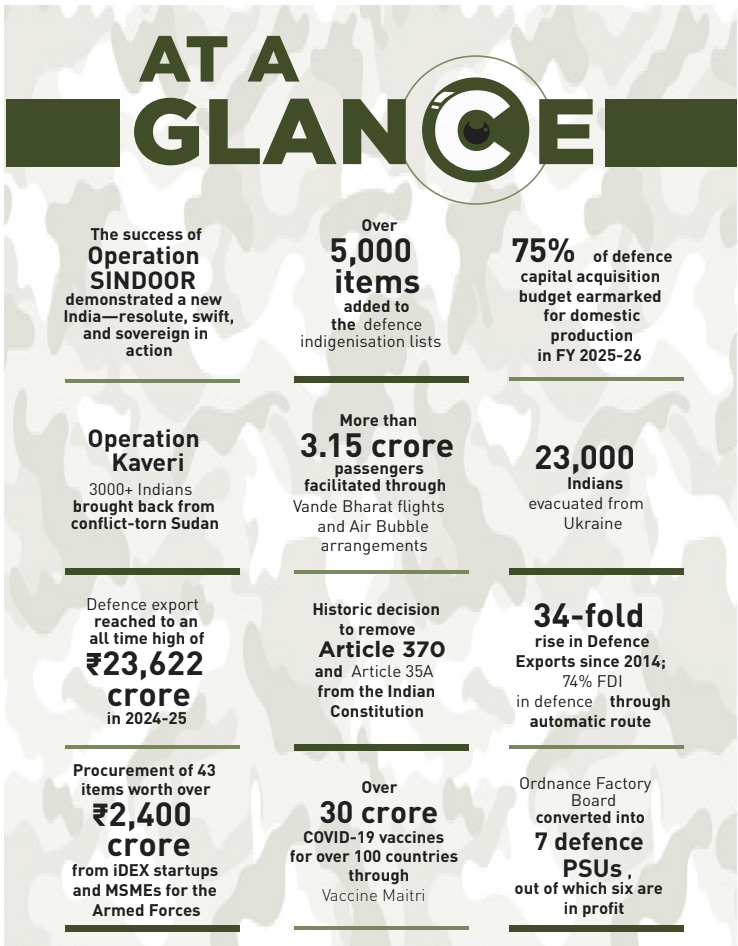
Operation Sindoor: Swift Justice Across Borders A defining moment of In- dia’s national security as- sertiveness was Operation Sindoor (May 7, 2025). This was a tri-services preci- sion military response to the Pahalgam terror attack. Conducted under India’s Integrated Command and Control Strategy, it neu- tralised nine terror camps across the border. The operation was mea- sured, non-escalatory, and highly focused, reflecting India’s capability to defend its sovereignty without destabilising the region. It showcased the country’s joint-force readiness, strate- gic foresight, and determinaion to respond to cross-border terrorism with precision and confidence. Earlier, India had demon- strated its resolve through the 2016 Surgical Strikes and the 2019 Balakot Air Strikes. Operation Sindoor builds on this doctrine of calibrated response, reinforcing that terrorism will not go unanswered.
Defence Indigenisation: Aatmanirbhar Bharat in Action The Modi government’s conviction that development and security go hand in hand has fuelled a massive push for defence self-reliance. The commissioning of the INS Vikrant, India’s first indig- enously built aircraft carrier, marked a milestone in mari- time power projection.
Key achievements in indigenisation include:
• Positive Indigenisation Lists of more than 5,000 defence items, banning their imports and mandating domestic production.
• Conversion of the Ord- nance Factory Board into seven defence PSUs, six of which are already in profit.
• 75% of the defence capi- tal acquisition budget in FY 2025–26 earmarked for domestic production.
• Induction of the Light Combat Helicopter (LCH) ‘Prachanda’, the only heli- copter in the world capable of operating at 5,000 metres with weapons and fuel.
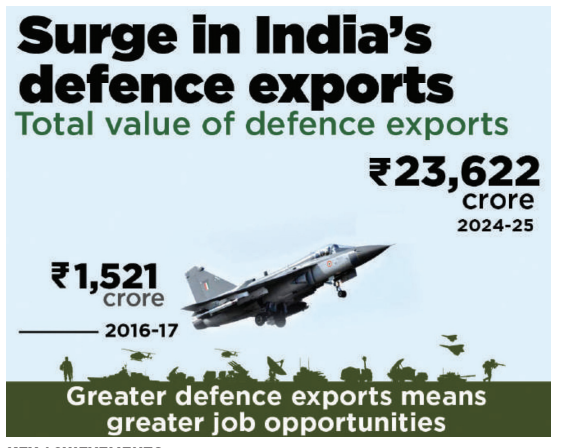
• Defence exports touching an all-time high of Rs 23,622 crore in 2024–25, a 34-fold increase since 2014.
The iDEX (Innovation for Defence Excellence) frame- work has empowered start- ups and MSMEs to supply cutting-edge systems. Pro- curement worth over Rs 2,400 crore from such in- novators has been made for the armed forces. Defence corridors in Uttar Pradesh and Tamil Nadu are emerging as hubs of indig- enous military production, promising both strategic autonomy and economic transformation.
Zero Tolerance on Terrorism
National security under Modi has been shaped by an uncompromising doctrine of zero tolerance against terrorism.
• No major terror attack has occurred in Indian cit- ies outside conflict zones since 2014.
• Perpetrators of terror have faced swift responses: surgical strikes (2016), Balakot airstrikes (2019), and now Operation Sindoor (2025).
• Terror sponsors have been isolated globally, with India ensuring that terrorism is no longer treated as a localised issue but as a central agenda in global forums.
• Legal measures such as amendments to the Unlaw- ful Activities (Prevention) Act (UAPA) have tightened India’s anti-terror architec- ture.
The government has also addressed internal secu- rity threats, bringing down left-wing extremism, while repealing Article 370 and 35A to integrate Jammu and Kashmir fully into India’s constitutional framework.
Cybersecurity and Emerging Threats In addition to physical threats, the Modi govern- ment has prioritised cyber- security. The Indian Cyber- crime Coordination Centre (I4C) and initiatives like e-Zero FIR have strength- ened the fight against digital financial crimes. Training of over 1,600 officials, certifi- cation of electronic evidence labs, and cybersecurity chal- lenges for start-ups reflect India’s preparedness for next-generation threats. India’s journey in national security and foreign policy under Prime Minister Na- rendra Modi has been de- fined by confidence, clarity, and conviction. Whether through the inclusive di- plomacy of the G20, the stra- tegic SAGAR vision, the measured decisiveness of Operation Sindoor, the bold push for defence indi- genisation, or the unyielding stance on terrorism, India has shown the world a na- tion that is both a responsible global power and a resolute defender of its sovereignty. As India looks ahead into the Amrit Kaal, this inte- grated approach to security and foreign policy ensures that the country remains stable at home, respected abroad, and prepared for the future.




