
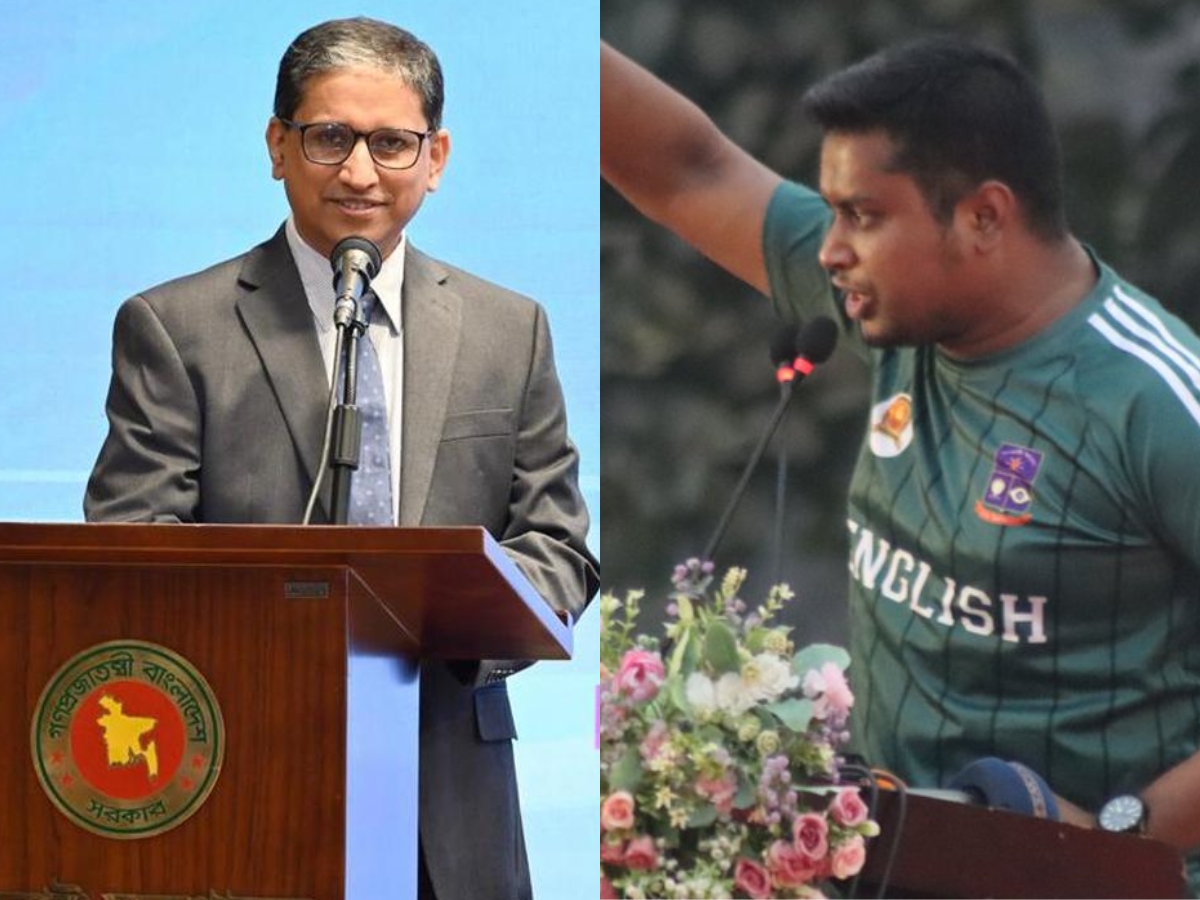

The Union government on Wednesday summoned Bangladesh’s High Commissioner to India, M. Riaz Hamidullah, amid concerns over the security of the Indian High Commission in Dhaka following days of protests outside the mission.
Officials familiar with the development said the Ministry of External Affairs (MEA) raised the issue after demonstrations were reported near the Indian diplomatic premises in the Bangladeshi capital. The high commissioner was seen leaving the ministry later in the afternoon after the meeting.
Threats to India’s Northeast by NCP Leader
The summons followed controversial remarks by Hasnat Abdullah, a senior NCP leader known for his strong anti-India stance, who publicly warned that Bangladesh could once again shelter separatist groups targeting India’s Northeast if the country were destabilised.
Hasnat Abdullah, a prominent leader of Bangladesh’s National Citizen Party (NCP), issued a warning on Monday, saying that Bangladesh could once again provide refuge to forces hostile to India, including separatist groups, to isolate India’s northeastern region from the mainland.
#WATCH | Delhi | Bangladesh High Commissioner leaves from the Ministry of External Affairs after a meeting on the security of the Indian High Commission in Dhaka, after a threat was received https://t.co/gn8ffQ1txb pic.twitter.com/kXNrBEw1zx
— ANI (@ANI) December 17, 2025
Over the last year, Bangladesh’s domestic political discourse has sharply turned confrontational toward India, with senior leaders openly hinting at reviving Dhaka’s past role as a rear base for insurgent activities targeting India’s Northeast.
‘We Will Destabilise India’: Bangladesh Leader Cites India’s North-Eastern States
Speaking at an all-party protest rally organised by Inqilab Mancha at Dhaka’s Central Shaheed Minar, Abdullah said, “If Bangladesh is destabilised, the fire of resistance will spread beyond borders. Since you are housing those who destabilise us, we will give refuge to the separatists of seven sisters too.”
He added, “I want to say clearly to India that if you shelter forces who do not respect Bangladesh’s sovereignty, potential, voting rights and human rights, Bangladesh will respond.”
Abdullah directly referenced India’s northeastern states, commonly known as the “Seven Sisters” – Arunachal Pradesh, Assam, Manipur, Meghalaya, Mizoram, Nagaland, and Tripura – warning that Dhaka could shelter anti-India forces with the potential to sever these states from India. His remarks drew loud applause from parts of the crowd.
Abdullah, who serves as the chief organiser for the southern region of the student-led NCP, is known for his strong anti-India rhetoric.
Not The First Threat – Muhammad Yunus’s Controversial Comments On India’s North East
Earlier this year, interim leader Muhammad Yunus sparked controversy by calling India’s Northeast “landlocked” while portraying Bangladesh as a strategic gateway to China. The remark was widely seen in New Delhi as an attempt to undermine India’s territorial and strategic interests.
Four of the seven states, Assam, Meghalaya, Tripura, and Mizoram, share long, porous borders with Bangladesh.
Bangladesh Renews Rhetoric Under Muhammad Yunus
The recent anti-India statements coincide with Dhaka’s apparent strategic drift under interim leader Muhammad Yunus, who has been accused of pulling Bangladesh closer to China and Pakistan while hardening positions against India.
Abdullah’s colleague and NCP convener Nahid Islam called for nationwide rallies against “Indian interference” on Victory Day, which commemorates Bangladesh’s independence from Pakistan in 1971.
“On Victory Day tomorrow, we will not take to the streets for celebration. We will take to the streets for resistance. In Dhaka and across Bangladesh, we will hold resistance rallies against Indian hegemony and all anti-Bangladesh conspiracies,” Islam said Monday.
Also Read: Donald Trump’s Gaza Plan Puts Pakistan Army Chief Asim Munir In A Fix: Send Troops Or Risk US Fury?
Zubair Amin is a Senior Journalist at NewsX with over seven years of experience in reporting and editorial work. He has written for leading national and international publications, including Foreign Policy Magazine, Al Jazeera, The Economic Times, The Indian Express, The Wire, Article 14, Mongabay, News9, among others. His primary focus is on international affairs, with a strong interest in US politics and policy. He also writes on West Asia, Indian polity, and constitutional issues. Zubair tweets at zubaiyr.amin




