
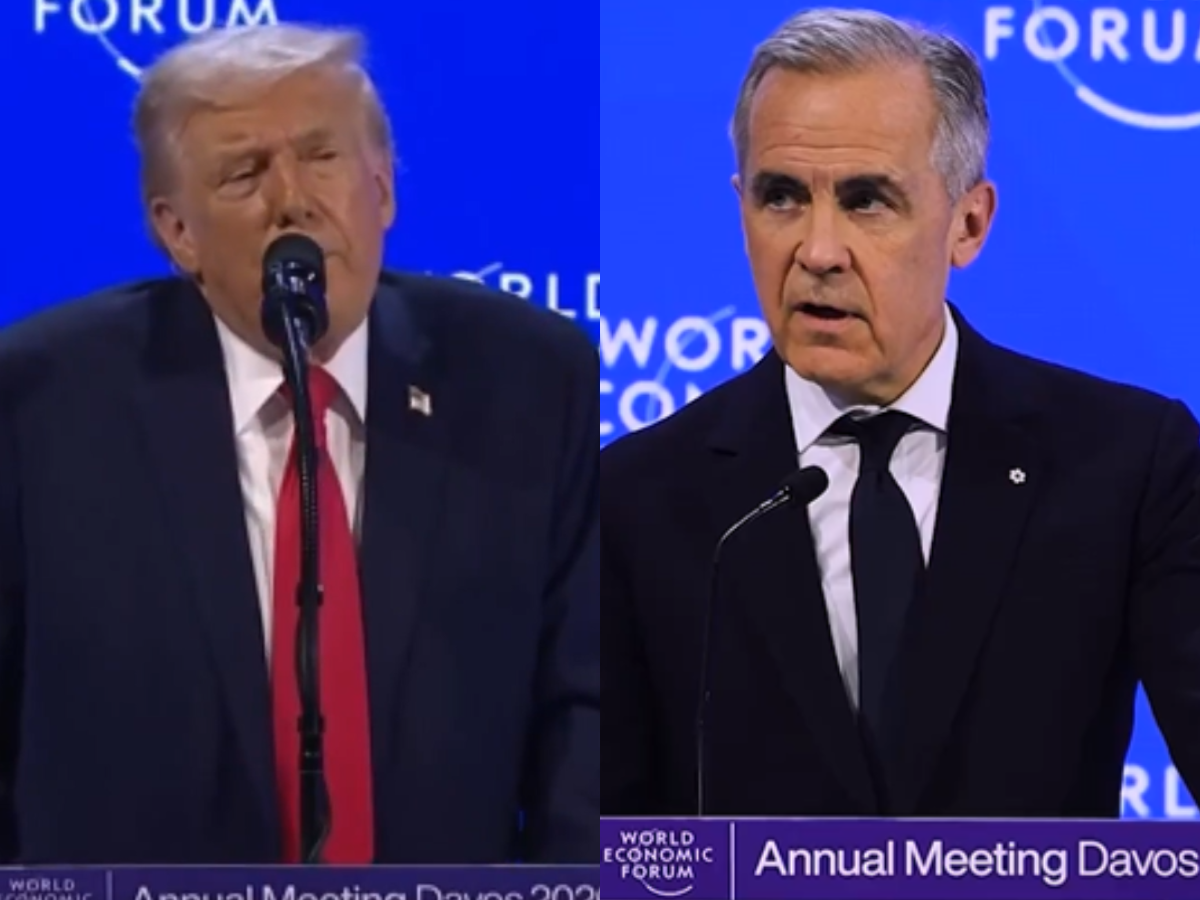

US President Donald Trump has warned that he will impose a 100 per cent tariff on all Canadian imports if Canada goes ahead with a trade deal with China. This statement has further escalated tensions between the two North American neighbours ahead of potential economic agreements.
Trump wrote on Truth Social that, “If Governor Carney thinks he is going to make Canada a ‘Drop Off Port’ for China to send goods and products into the United States, he is sorely mistaken,”. He further added that, “China will eat Canada alive, completely devour it, including the destruction of their businesses, social fabric, and general way of life. If Canada makes a deal with China, it will immediately be hit with a 100% Tariff against all Canadian goods and products coming into the U.S.A.”
According to reports, the tariff threat comes after reports that Canada and China have been discussing a deal that could reduce tariffs on Chinese electric vehicles and other goods, while Canada would benefit from lower duties on agricultural products. Canada has acknowledged its heavy dependence on the US and they are trying to diversify their trade ties by this move which clearly has irked Trump.
Trump imposing tariffs to maintain influence?
Trump’s warning fits his protectionist trade approach, which he has consistently followed. In the past, he has imposed tariffs on multiple countries, including China, Mexico, and Canada. He has claimed that he has imposed tariffs to protect American industries and workers. However, several analysts have said that the US fears losing influence if Canada becomes economically closer to China.
Furthermore, several experts say that Canada’s proposed trade deal with China comes at a sensitive time globally which was reflected in Canada PM Mark Carney’s fiery Davos speech. It is reported that Trump reacted so strongly because this trade deal strengthens economic ties between Canada and China and could shift regional influence and trade dynamics out of the US’ favour.
Canadian Prime Minister Mark Carney recently addressed the World Economic Forum in Davos, where he said that middle powers like Canada should protect their sovereignty and pursue diversified trade and diplomatic strategies independent of dominant superpowers. Carney’s speech received a standing ovation at Davos summit. He explicitly mentioned the need for Canada to secure its economic future and maintain independence, even if it involves deeper engagement with China.




