
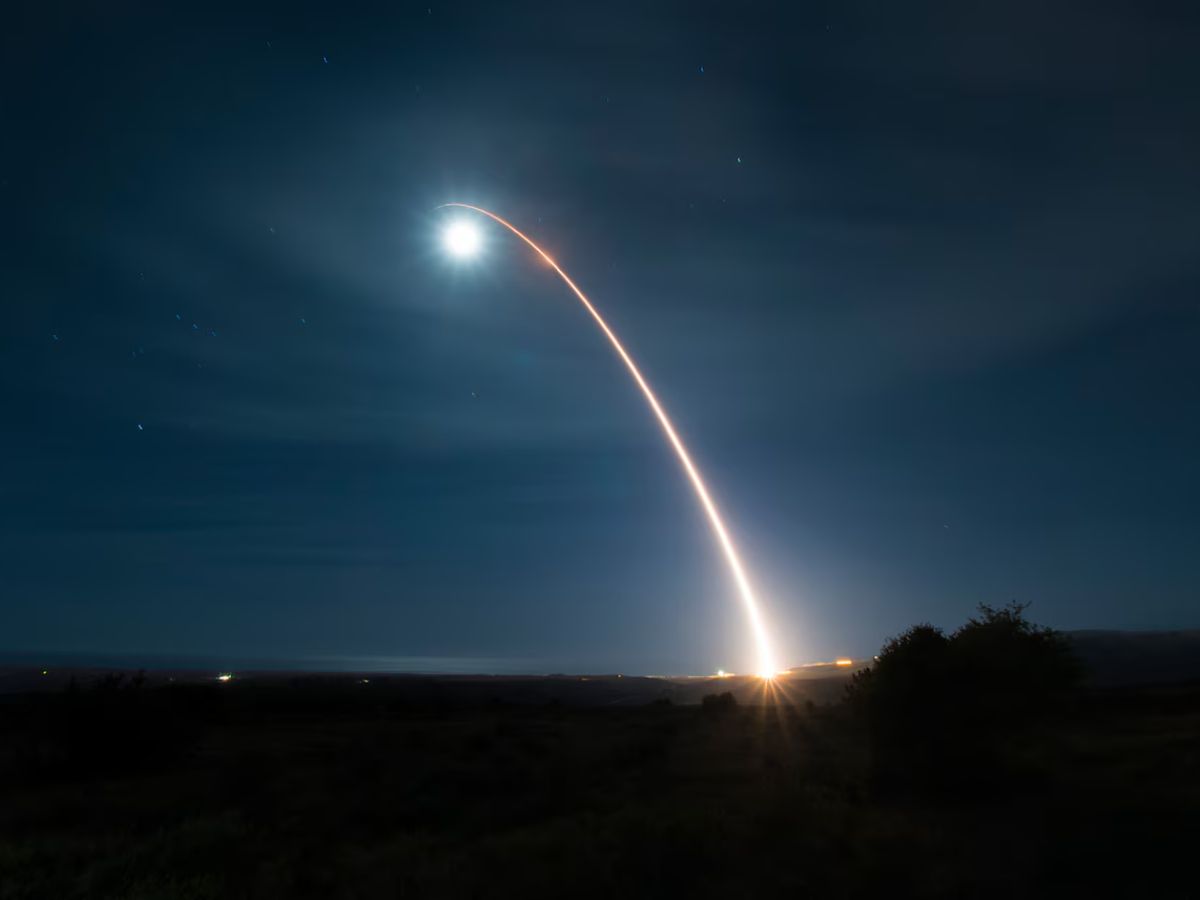

The United States carried out a test launch of a Minuteman III Intercontinental Ballistic Missile (ICBM) early Wednesday, following President Donald Trump’s recent directive to restart US nuclear weapons testing. The launch, conducted by the Air Force Global Strike Command from Vandenberg Space Force Base in California, was executed without incident.
The unarmed missile traveled approximately 4,200 miles across the Pacific Ocean and landed near the Army’s Ronald Reagan Ballistic Missile Defense Test Site on Kwajalein Atoll in the Marshall Islands.
The test, originally scheduled months ago, gained heightened attention after Trump announced last week that the US would resume nuclear weapons testing for the first time in more than three decades.
Minuteman III: Part of US Nuclear Triad
The Minuteman III arsenal forms one leg of America’s nuclear deterrent, intended for use only in response to a nuclear attack by an adversary. In addition to ICBMs, the United States maintains nuclear weapons capable of launch from submarines and strategic bombers, together forming the country’s nuclear triad.
Also Read: Asim Munir To Rule Pakistan For Life? Islamabad Plans Constitutional Amendment, Know All About It
President Trump had stated on social media that the testing process would begin “immediately,” drawing attention from US allies and nuclear rivals, including Russia and China. Energy Secretary Chris Wright later clarified that the tests would not involve actual nuclear detonations, unlike historic tests.
Since 1992, the US has observed a moratorium on explosive nuclear testing. However, unarmed test launches of ICBMs and submarine-launched ballistic missiles (SLBMs) are regularly conducted to ensure that the nation’s nuclear forces, including nuclear-capable bombers, remain effective as a strategic deterrent.
GT 254 Test Details
The GT 254 launch was executed under the supervision of the US Air Force Global Strike Command, which manages the nation’s ICBMs and nuclear-capable bombers. The missile carried a reentry vehicle, designed to house a nuclear warhead, and flew west across the Pacific before reaching its target in the Marshall Islands.
The test launch was initiated via the Airborne Launch Control System, a backup command and control system for land-based ICBMs, from aboard a U.S. Navy E-6B aircraft. The system’s use allows the ICBM force to remain operational even if ground launch sites are compromised.
The Test Squadron overseeing GT 254 described the operation as a “comprehensive assessment,” noting that it collected “invaluable” data to confirm the reliability and accuracy of the Minuteman III system.
US Nuclear Arsenal
The Minuteman III, which has been in service since 1970, is scheduled to be replaced by the next-generation Sentinel missile. In the interim, maintaining the readiness of the existing ICBM arsenal is a priority.
According to the Federation of American Scientists’ Nuclear Information Project, the US Air Force deploys 400 Minuteman III missiles, each currently carrying a single warhead, across silos in Colorado, Montana, Nebraska, North Dakota, and Wyoming. While primarily controlled by ground launch centers, the missiles can also be launched through the Airborne Launch Control System aboard E-6B aircraft.
As of January 2025, the S. nuclear arsenal includes an estimated 3,700 warheads in deployment and reserve, with approximately 800 assigned to the ICBM force. Roughly half of these ICBM warheads are currently deployed, according to the Nuclear Information Project.
Also Read: Will Russia Restart Nuclear Testing Soon? Vladimir Putin Issues Big Statement, Says If Donald Trump…
Zubair Amin is a Senior Journalist at NewsX with over seven years of experience in reporting and editorial work. He has written for leading national and international publications, including Foreign Policy Magazine, Al Jazeera, The Economic Times, The Indian Express, The Wire, Article 14, Mongabay, News9, among others. His primary focus is on international affairs, with a strong interest in US politics and policy. He also writes on West Asia, Indian polity, and constitutional issues. Zubair tweets at zubaiyr.amin




