
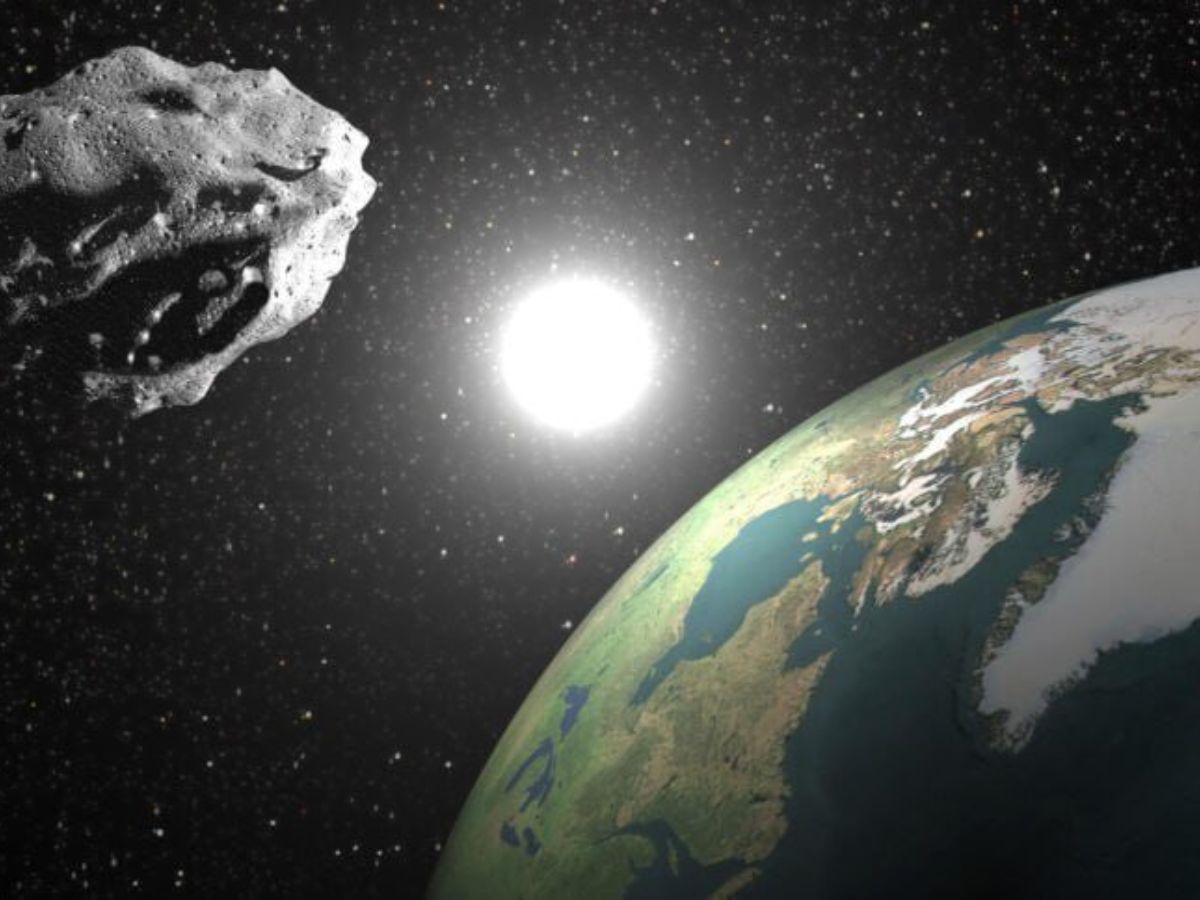

Astronomers from the University of Hawaii have identified a new quasi-moon, officially named as 2025 PN7, adding to Earth’s small family of temporary natural companions. The discovery, made during the summer of 2025, reveals a cosmic object estimated to be 18 to 36 meters wide, roughly the size of a small building.
Is 2025 PN7 A True Moon?
Unlike the Moon, 2025 PN7 is not gravitationally bound to Earth. Instead, it orbits the Sun along a path closely aligned with Earth’s, moving in tandem as the planet circles our star. Scientists compare the motion to “two runners on a track, moving at the same pace, close together but never directly connected.”
“This discovery adds a fascinating new member to Earth’s extended neighborhood,” said astronomers involved in the observation.
Also Read: What Is Project Astronaut? Launched By Axiom Space, All You Need To Know
Quasi-Moon 2025 PN7 Features
Researchers estimate that 2025 PN7 has likely been accompanying Earth for around 60 years. If its orbit remains stable, it will continue to travel alongside our planet until 2083, after which it is expected to drift away into open space.
The quasi-moon’s distance from Earth varies considerably due to the gravitational pull of the Sun and nearby planets. At its closest approach, it comes within 4 million kilometers, roughly ten times the distance to the Moon, and at its farthest, it can swing out to 17 million kilometers.
Earth has a new quasi-satellite
Astronomers from the Pan-STARRS observatory in Hawaii have reported the discovery of a quasi-moon 2025 PN7, which has been moving near Earth unnoticed for decades. Analysis has shown that this asteroid is about 19 meters in diameter and is in an… pic.twitter.com/ZE2mI3a7J7
— Black Hole (@konstructivizm) September 13, 2025
The University of Hawaii team first spotted 2025 PN7 during a routine telescope survey earlier this year. Initially appearing as a faint speck against the backdrop of stars, subsequent observations revealed that it was traveling at the same pace as Earth around the Sun. After weeks of careful monitoring, NASA confirmed that the planet had gained a temporary traveling companion.
Earth And Its Quasi-Moons
To date, astronomers have confirmed only eight quasi-moons around Earth and other planets, making each one a valuable case study for understanding asteroid behavior and gravitational interactions.
NASA notes that 2025 PN7 is the smallest and least stable of these quasi-moons. Its 19-meter diameter makes it difficult to observe, with limited visibility windows occurring at specific times and angles.
NASA: Earth now has two moons until 2083! Newly found quasi-moon 2025 PN7, about 18-36m wide, orbits the Sun alongside Earth in a similar path, staying as a companion for decades before drifting away. pic.twitter.com/xcxfhAhQ4F
— GeoTechWar (@geotechwar) October 20, 2025
Despite its size, the quasi-moon offers a significant scientific opportunity. Carlos de la Fuente Marcos, a space expert, highlighted its potential:
“Small, nearby asteroids could serve as ideal testing grounds for future unmanned space missions.”
Although 2025 PN7 will not be visible to the naked eye like the Moon, it will remain a quasi-satellite of Earth for the coming decades, traveling alongside our planet on its journey around the Sun.
Zubair Amin is a Senior Journalist at NewsX with over seven years of experience in reporting and editorial work. He has written for leading national and international publications, including Foreign Policy Magazine, Al Jazeera, The Economic Times, The Indian Express, The Wire, Article 14, Mongabay, News9, among others. His primary focus is on international affairs, with a strong interest in US politics and policy. He also writes on West Asia, Indian polity, and constitutional issues. Zubair tweets at zubaiyr.amin




