
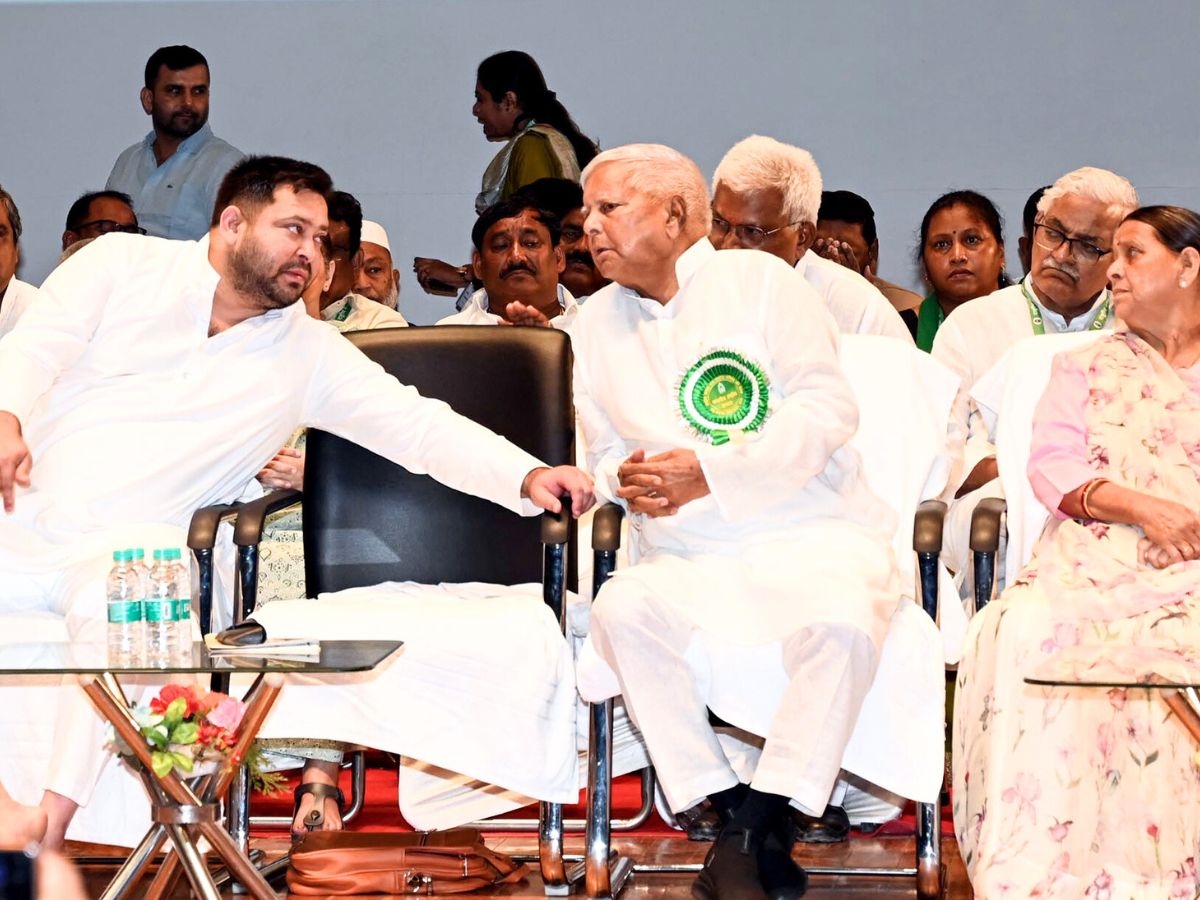

The 2025 Bihar Assembly elections delivered a brutal reality check for the Rashtriya Janata Dal (RJD). Winning just 25 seats, the party that once dominated the state’s political center collapsed under the weight of internal feuds, strategic blunders, and a widening disconnect with key voter groups. The NDA swept a massive 202 of 243 seats, leaving the Mahagathbandhan with only 33.
A Dynasty in Disarray: Family Feud Goes Public
An ailing Lalu Prasad Yadav watched his political legacy unravel in real time. The long-simmering rift between his sons, Tej Pratap Yadav and Tejashwi Yadav, exploded months before the polls. What began with Tej Pratap’s controversial Facebook post about a 12-year relationship quickly spiralled into a public meltdown.
Lalu Prasad took the unprecedented step of expelling Tej Pratap for six years. That triggered accusations, emotional posts from sister Rohini Acharya, and allegations that outsider and Rajya Sabha MP Sanjay Yadav was acting as a “Jaichand” within the party.
With Tej Pratap floating his own outfit the Janshakti Janata Dal and directly contesting against RJD candidates, the Yadav vote splintered. In Mahua, the decades-old RJD bastion, Tej Pratap finished a distant third, helping the NDA clinch the seat.
The feud was not just a family matter. A StateVibe poll showed nearly 30% of voters felt the Yadav family rift hurt the alliance’s chances a sentiment that was reflected in the final mandate.
Seat-Sharing Chaos and Weak Coordination
While the NDA projected unity through its “Five Pandavas” branding, the Mahagathbandhan appeared confused and disjointed. Seat-sharing talks dragged on for weeks. Several candidate lists were announced on the last day of nomination, leaving voters unsure of who represented whom.
Worse, in over a dozen constituencies including Vaishali, Chainpur and Bachhwara alliance partners competed against each other, splitting anti-incumbency votes and handing easy wins to the BJP and JDU.
The EBC Strategy Backfired
Attempting to woo Bihar’s 36% Extremely Backward Classes (EBCs), the Grand Alliance named Mukesh Sahni as its deputy CM face. But the move polarised rather than united. Sub-castes within the EBC umbrella did not identify with Sahni, and his party failed to win a single seat.
Meanwhile, the RJD offered no similar representation to Muslims (17%) or SCs (19%) two crucial support bases that felt sidelined.
Campaign Centred on Tejashwi, Not the Alliance
Despite being a coalition, the opposition campaign revolved almost entirely around Tejashwi Yadav. The RJD’s manifesto marketed as “Tejashwi Pran”created resentment among Congress, Left and VIP workers who felt ignored.
In contrast, the NDA fielded a cohesive team that maximised outreach at every level.
Promises Without a Roadmap
Tejashwi’s biggest promise one government job for every household was seen as unrealistic. With 26 million households in Bihar, the plan lacked a clear roadmap. The NDA milked this aggressively, framing the promise as impractical and hollow.
Meanwhile, Nitish Kumar’s late push transferring ₹10,000 directly into women’s bank accounts struck deeper. Women, who constituted nearly 71% of voters, decisively backed the NDA. The RJD’s own women-focused scheme failed to gain traction.
Narratives RJD Failed to Counter
The Congress-led “vote chori” narrative fizzled out. The alliance rarely addressed core issues like poor infrastructure, lack of jobs, crime, and education.
On the other hand, the NDA repeatedly evoked the “Jungle Raj” tag and the RJD could not effectively counter it. Memories of the party’s past governance continued to overshadow Tejashwi’s pitch for change.
A Lost Connect With Bihar’s Ground Reality
The RJD entered the race hoping to capitalize on real issues. But infighting, emotional outbursts, and constant online drama overshadowed the ground campaign. The party’s weakest moment coincided with a high-stakes election and Bihar’s voters noticed.
Even though Tejashwi held on to Raghopur, it felt like a narrow escape rather than a victory.
A Lesson in Strategy and Stability
The RJD’s defeat in the Bihar Elections 2025 was not just about numbers it was a collapse of coordination, credibility, and unity. Strategic missteps, internal battles, and a failure to connect with key voter groups left the party vulnerable.
For Tejashwi Yadav, the path ahead will require rebuilding trust, mitigating family rivalries, and presenting a coherent, inclusive vision for Bihar. The “Dara Shikoh curse” may be symbolic, but in 2025, it became the metaphor for RJD’s self-inflicted fall.
Sofia Babu Chacko is a journalist with over five years of experience covering Indian politics, crime, human rights, gender issues, and stories about marginalized communities. She believes that every voice matters, and journalism has a vital role to play in amplifying those voices. Sofia is committed to creating impact and shedding light on stories that truly matter. Beyond her work in the newsroom, she is also a music enthusiast who enjoys singing.




