
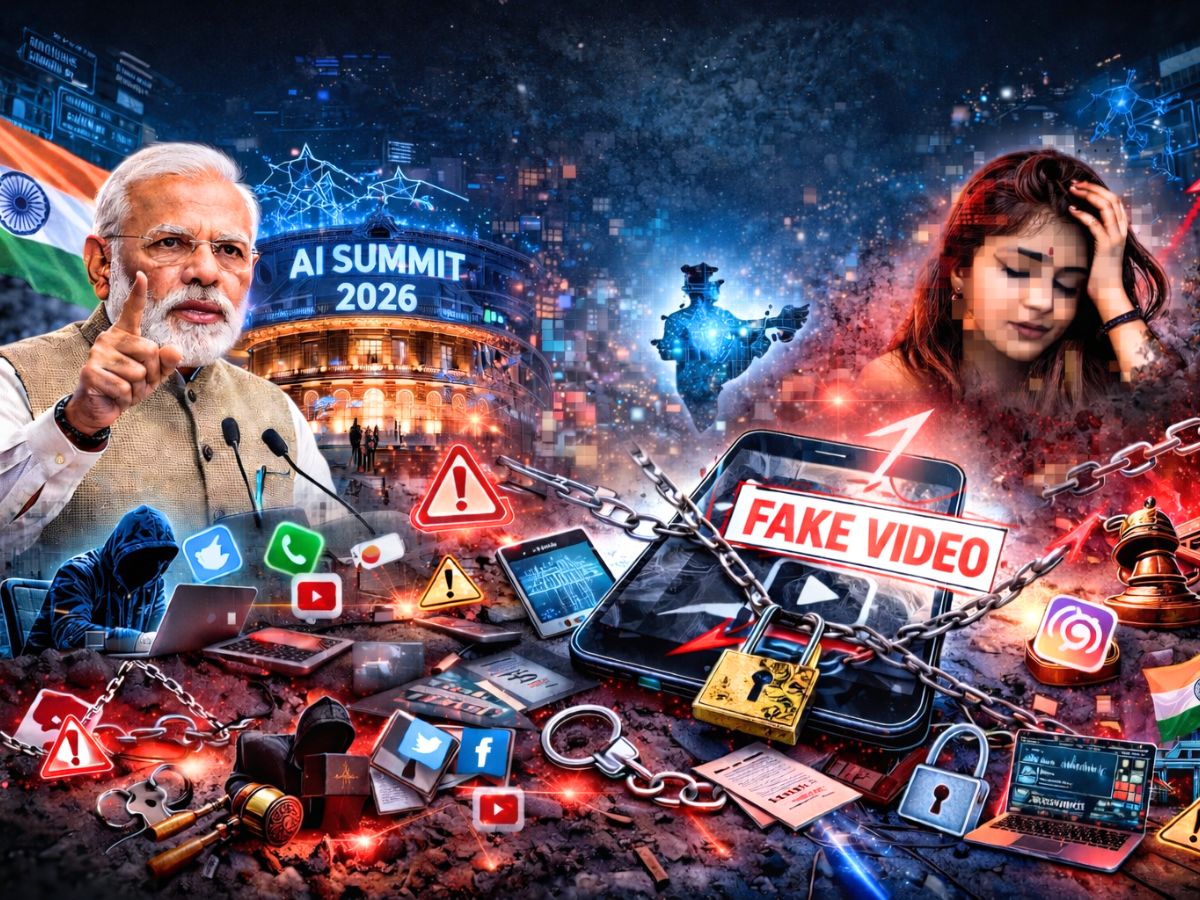

At the India AI Impact Summit 2026, happening at Bharat Mandapam in Delhi from February 16-20, experts and policymakers highlighted the growing dangers of deepfakes, AI-generated misinformation, and viral clickbait content.
The summit brought together ministers, cybersecurity specialists, and global tech leaders to discuss responsible AI use and strategies to curb the misuse of technology in media and digital spaces.
PM Modi and IT Minister Ashwini Vaishnaw Warn of Deepfake Threats
Union Electronics and IT Minister Ashwini Vaishnaw stressed that deepfakes and synthetic content are emerging as significant threats to democracy, creative industries, and the credibility of information.
Speaking on Wednesday, he emphasized the importance of developing legal frameworks to tackle AI-driven misinformation in India. “Fake news is a threat to democracy,” he said, calling for global cooperation to regulate AI responsibly.
Prime Minister Narendra Modi echoed this warning, calling for international standards in artificial intelligence. He highlighted that deepfakes and fabricated content could destabilize open societies and advocated for authenticity labels on digital content to curb misinformation.
Viral MMS Controversies Highlight the Cyber Threat
The discussion is particularly relevant in light of recent viral MMS controversies circulating on social media. From Pakistani social media personality Alina Amir, popularly known as the “Sarsarahat Girl,” to the widely searched “Angel Nuzhat 12-minute video,” these incidents demonstrate how cybercriminals exploit curiosity to spread malware, phishing scams, and clickbait content.
Cybersecurity experts confirm that these so-called “leaked” videos are not verified scandals but carefully engineered campaigns designed to hijack trending searches and manipulate social media algorithms. Users clicking on these links are often redirected to malicious websites, betting platforms, or malware downloads, a tactic known as SEO poisoning.
The Angel Nuzhat and Alina Amir Clickbait Cases
Investigations into the Angel Nuzhat 12-minute MMS trend revealed that the name itself is likely fabricated for clickbait purposes. Similarly, posts circulating under Alina Amir’s name use sensational thumbnails and captions to trigger clicks but rarely lead to actual content.
Cybersecurity analysts warn that malware embedded in these links can steal banking credentials, hijack social media accounts, and compromise private data without the user realizing it.
This pattern mirrors earlier viral hoaxes involving public figures such as Arohi Mim and Mathira Khan, where AI-generated deepfakes were used to spread fabricated content for financial gain.
How Cybercriminals Exploit Deepfakes and Clickbait
Experts explain that cybercriminals constantly monitor trending search terms. Once a name gains traction, fake landing pages, Telegram groups, and shortened URLs are created within hours.
Some even exploit trusted domains, such as educational websites, to host fake content, increasing the perceived legitimacy of the links.
AI-powered deepfake technology has made it easier to create realistic but fake images and videos, amplifying the risk of misinformation.
Analysts warn that digital voyeurism, or the online search for sensational “leaked” content, plays directly into the hands of scammers. Each click fuels the cycle of viral exploitation.
Staying Safe Online amid deepfake threats
Cybersecurity professionals advise users to avoid clicking on suspicious links, especially those promising “full leaked videos.” Verification through credible news sources is essential.
Using multi-factor authentication, unique passwords, and adjusting privacy settings can further reduce exposure to deepfake scams. Updating devices and software regularly also ensures that security vulnerabilities are patched promptly.
The Future of Digital Safety in India
India’s commitment to regulate deepfakes at the AI Summit 2026 reflects a growing effort to prevent phishing, malware, and cyber fraud online.
By promoting authenticity labels and encouraging global cooperation, policymakers hope to create a safer digital environment.
As viral MMS trends like Alina Amir and Angel Nuzhat demonstrate, clickbait-driven misinformation is a persistent threat. Experts emphasize that in the age of AI, users must “verify before you click” and prioritize digital security over curiosity.
The question remains whether India’s regulatory push can mark the beginning of a safer, more trustworthy online ecosystem.
Sofia Babu Chacko is a journalist with over five years of experience covering Indian politics, crime, human rights, gender issues, and stories about marginalized communities. She believes that every voice matters, and journalism has a vital role to play in amplifying those voices. Sofia is committed to creating impact and shedding light on stories that truly matter. Beyond her work in the newsroom, she is also a music enthusiast who enjoys singing.




